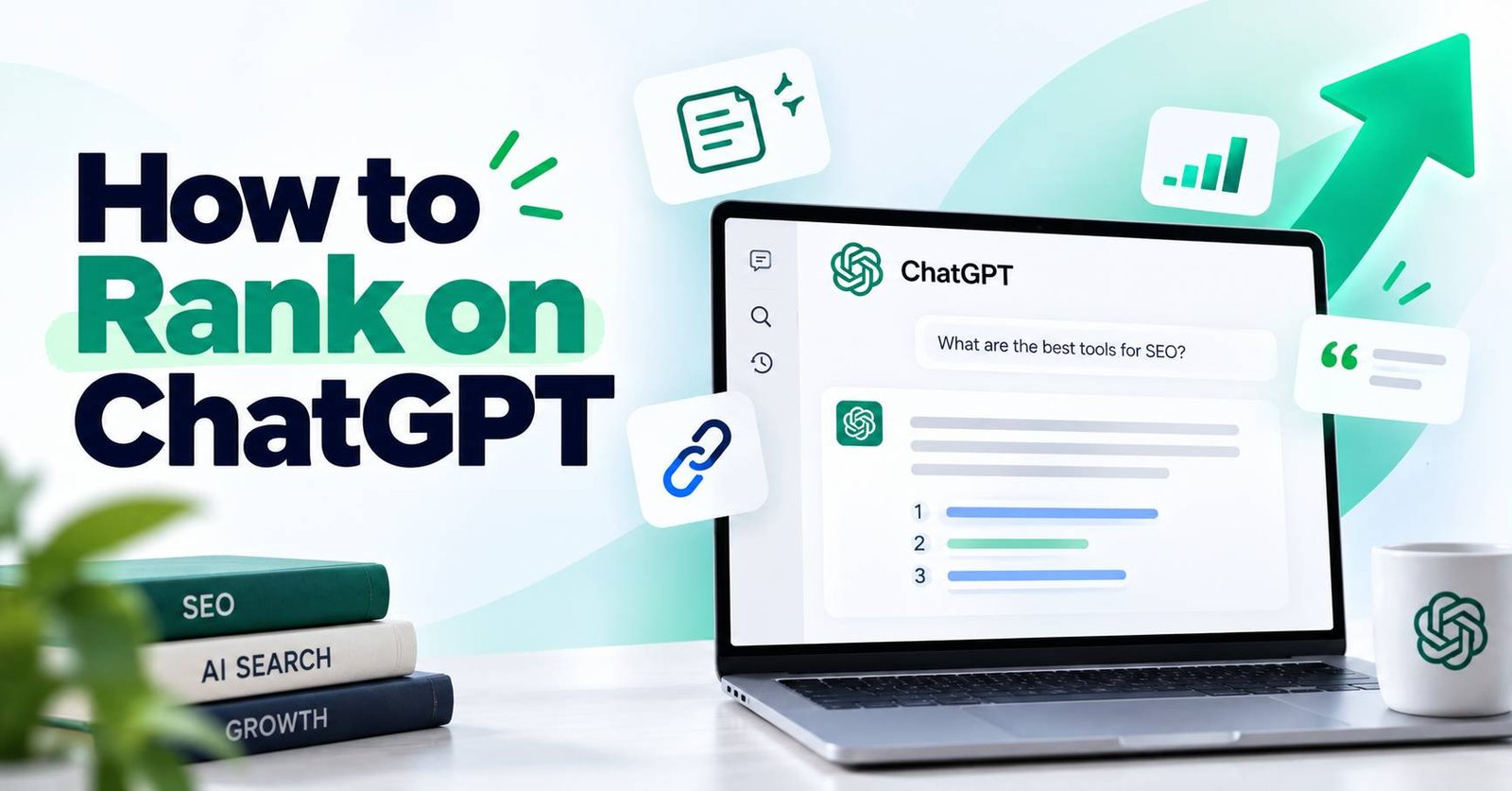
Getting your brand or content mentioned inside a ChatGPT answer comes down to five repeatable moves: figuring out what your customers actually ask, checking who currently gets cited for those questions, building content that’s easy for a model to lift and reuse, earning outside validation for your site, and rechecking your results on a schedule. It’s a different game than climbing a Google results page, there’s no fixed spot to defend. One academic study out of Princeton measured up to a 40% jump in how often a page got cited after specific content changes, though that lift is a shifting probability, not a locked-in rank.
Generative Engine Optimization (GEO) describes the work of shaping content so tools like ChatGPT, Perplexity, and Google’s AI Overviews choose to reference it while composing an answer. Where SEO fights for a ranked spot in a list of links, GEO fights for a mention buried inside a paragraph the model wrote itself and the scoreboard is how often that mention happens, not where a link lands.
What does “Generative Engine Optimization” actually mean?
It’s the practice of shaping content specifically so an AI system picks it as source material when generating a response. Researchers Aggarwal and colleagues, working across Princeton, Georgia Tech, IIT Delhi, and the Allen Institute for AI, coined the term in a 2024 paper and built GEO-bench, a 10,000-question test bed for measuring which edits change how often a source gets picked up.
- Classic SEO chases a ranked position among search links
- GEO chases a mention woven into a generated response
- Neither discipline stands alone, authority-building work for one tends to feed the other
Where do you find the questions worth targeting?
Skip guessing at keywords the way you might for Google, and instead surface the literal questions your buyers type into ChatGPT, either by prompting ChatGPT itself to list likely questions in your space, or by digging through your own sales calls, support threads, and community discussions for the phrasing real customers use.
- Genuine customer wording out-performs invented keywords, because retrieval is a language-matching exercise
- Aim for a running list of 20–50 prompts per subject area
- Revisit the list every quarter, since how people phrase questions drifts
How do you figure out who ChatGPT is already citing?
Feed your prompt list into ChatGPT and track which sites, brands, and content types keep showing up, keeping in mind that a large slice of what ChatGPT pulls from the open web overlaps with what already performs well on Bing.
- Submitting your sitemap to Bing Webmaster Tools takes minutes and gets skipped constantly
- Flag which competitors keep appearing, and for exactly which prompts
- Bookmark any roundup or “best of” pages that seem to be feeding the answer
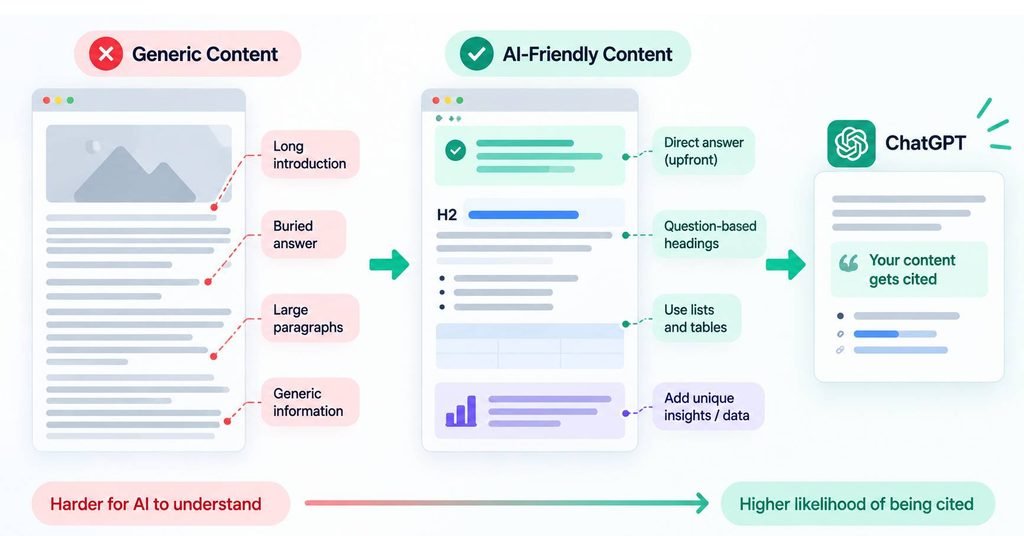
What makes content more likely to get pulled into an answer?
Pages get lifted more often when they lead with a complete, standalone answer and lean on formatting a model can parse quickly, rather than burying the point in a long lead-up.
- Put the actual answer in the opening 80–100 words, ahead of any explanation
- Turn each subheading into the real question a reader would ask, then answer it right underneath
- Favor lists and tables over paragraphs, they’re easier for a model to lift cleanly
- Add something genuinely yours, a stat, a take, a framework, since models are tuned to skip over content that just repeats what’s already out there
Is old-school SEO still worth doing alongside this?
Definitely, domain authority, inbound links, and basic technical SEO hygiene all still feed into whether a generative engine trusts your page enough to cite it, and landing on a niche “best of” list nets you a backlink and third-party validation in one move.
Worked Example: Applying the Framework to One Prompt
Here’s how the five steps look in practice against a single target question: “best project management tool for small teams.”
Step 1 — Prompt research: Beyond that head-term question, related variants worth tracking include “what project management tool do startups use,” “Asana vs Monday vs ClickUp for small teams,” and “free project management software for 5-person team.” Each phrasing can pull up a different set of cited sources.
Step 2 — Results analysis: Running those questions typically turns up a blend of established review sites (G2, Capterra, Zapier’s blog) alongside vendors’ own comparison pages. The pattern to watch: pages already ranking on Bing for these terms tend to resurface as ChatGPT’s picks, and roundup-style posts (“10 best PM tools for small teams”) get pulled in more often than single-product pages do.
Step 3 — Content creation: A page built to compete here would open with something like “The best project management tools for small teams in 2026 are X, Y, and Z, based on pricing, setup time, and team-size limits,” then move into a comparison table, then question-based subheadings covering pricing, integrations, and learning curve.
Step 4 — Authority building: Landing a link from an existing “best of” roundup, or earning enough backlinks to crack page one of Bing for the same search, meaningfully raises the odds this page gets folded into future ChatGPT answers.
Step 5 — Tracking: Rerunning those four prompt variants every 2–4 weeks shows whether the new page starts turning up, and whether it adds to or replaces the sources already being cited.
Treat this as a template for structuring your own tracking work — it’s not a reported result or a promised outcome.
Data & Proof Points
- Aggarwal and colleagues’ 2024 study (presented at ACM SIGKDD, arXiv:2311.09735) ran nine different content tactics through 10,000 test queries. Three of them, working in real statistics, naming credible sources, and adding relevant quotes, each raised citation visibility by roughly 30–40%, with the biggest lift coming from stacking tactics together rather than using just one.
- That same research found keyword stuffing backfired, and that shallow, cosmetic text edits on their own weren’t dependable, the gains came from substantive changes, not surface tweaks.
- A separate look at more than 55,000 queries spanning six different LLM-powered search tools found a sizable chunk of the domains these tools cited never showed up in ordinary search results at all, ranking on Google is no guarantee of a ChatGPT mention.
- ChatGPT’s citations for open-web content line up closely with what Bing already indexes, which is why a Bing Webmaster Tools submission is such a cheap, high-value step.
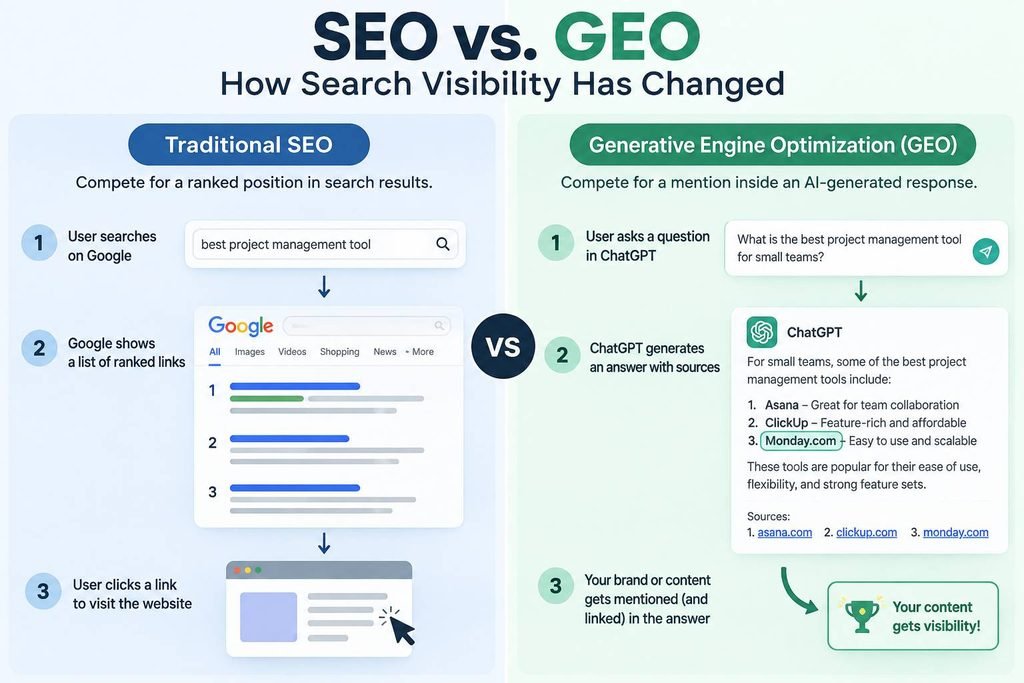
Comparison Table
| Approach | Best for | Key limitation |
| Traditional SEO | Ranking in Google’s ten blue links | Doesn’t guarantee AI citation, a large share of AI-cited domains never appear in standard search results |
| GEO (content-only) | Improving citation odds for existing pages | Effects are correlational and vary by topic; there’s no fixed rank to hold onto |
| GEO + authority building | Long-term, durable AI visibility | Slower path, depends on backlinks and repeated outside mentions, not just page edits |
FAQ
Q: How long does it take to rank on ChatGPT?
A: There’s no set timeline. Most people working in this space suggest giving each content change 30–90 days before judging it, with a full 3–6 month cycle needed to see the compounding payoff of repeated iteration.
Q: Does traditional SEO still matter if I’m doing GEO?
A: Yes — authority, backlinks, and technical SEO fundamentals all still play into whether an AI system cites your page, so GEO sits on top of SEO rather than replacing it.
Q: What’s the single highest-impact content change?
A: Working in specific, checkable statistics and naming credible sources produced the strongest measured gains in the Princeton-led research.
Q: Can I track ChatGPT rankings the way I track Google rankings?
A: Not really — there’s nothing like Search Console for this. Tracking means manually rerunning your prompt list every couple of weeks and logging what shows up, knowing results can shift between sessions and even small changes in phrasing.
Q: Should I copy competitor content that’s already getting cited?
A: No. These systems are built to skip over recycled material in favor of something original, so copying is more likely to work against you than for you.

Ganesh Jalla is a highly skilled SEO consultant with over 8 years of experience in the digital marketing industry. With a focus on driving organic traffic and maximizing online visibility, Ganesh and his team at Search Sprout provide tailored solutions to help businesses thrive in today’s competitive landscape.