
The Philippines has 98 million internet users. They spend an average of 54 hours a week consuming digital media, the second-highest in the world. More than half buy something online every single week.
And yet, many Philippine businesses are still running their marketing playbook from 2019, pushing Facebook posts and running the occasional boosted ad, while their customers have moved on to an entirely different way of discovering, researching, and buying products online.
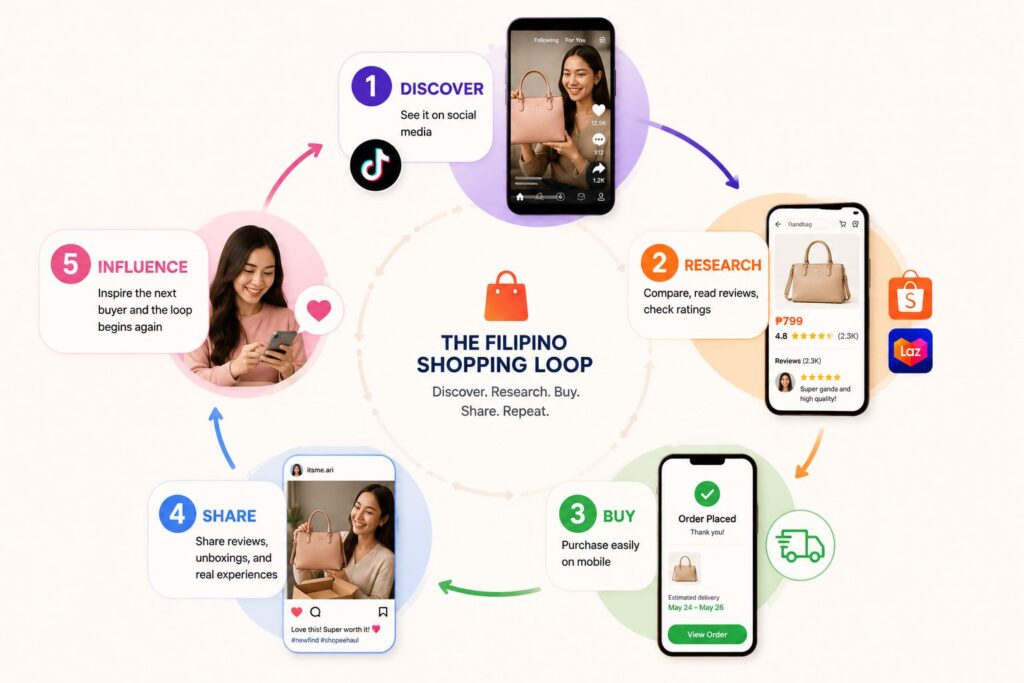
The Filipino consumer journey in 2026 does not look like a funnel. It looks like a loop. A product gets discovered on TikTok, researched through Shopee reviews, purchased on mobile, and then shared as an unboxing post that pulls the next buyer in. Brands that understand each stage of this loop win. Brands that don’t keep spending more for less.
Why the Philippines Needs Its Own Marketing Playbook
Filipinos are not just connected, they are deeply, habitually online. The average Filipino spends 8 hours and 52 minutes online every day and 54 hours a week consuming digital media overall. For context, the global average sits at around 40 hours per week. The Philippines has consistently ranked in the top three globally for digital engagement for multiple years running.
Source: Digital 2026 Report — Meltwater (October 2025)
Several structural factors drive this. Smartphone adoption is effectively universal, cellular connections at 137 million exceed the total population of 117 million. Mobile data is affordable. The average Filipino household of 4.2 people shares devices, keeping engagement high across demographics and age groups.
For businesses, the implication is direct: your customers are reachable online at almost any hour of the day. The question is not whether to invest in digital, it is where and how.
The Platform Mix Is Unlike Western Markets
In the US or UK, the typical discovery-to-purchase journey might look like: Google search → brand website → checkout. In the Philippines in 2026, the dominant pattern looks very different:
- TikTok / Facebook / YouTube — social discovery and first impression
- Shopee / Lazada / TikTok Shop — price comparison, reviews, and purchase
- Messenger / Viber — customer service and repeat orders
- Facebook groups and peer reviews — post-purchase validation and the next buyer’s discovery
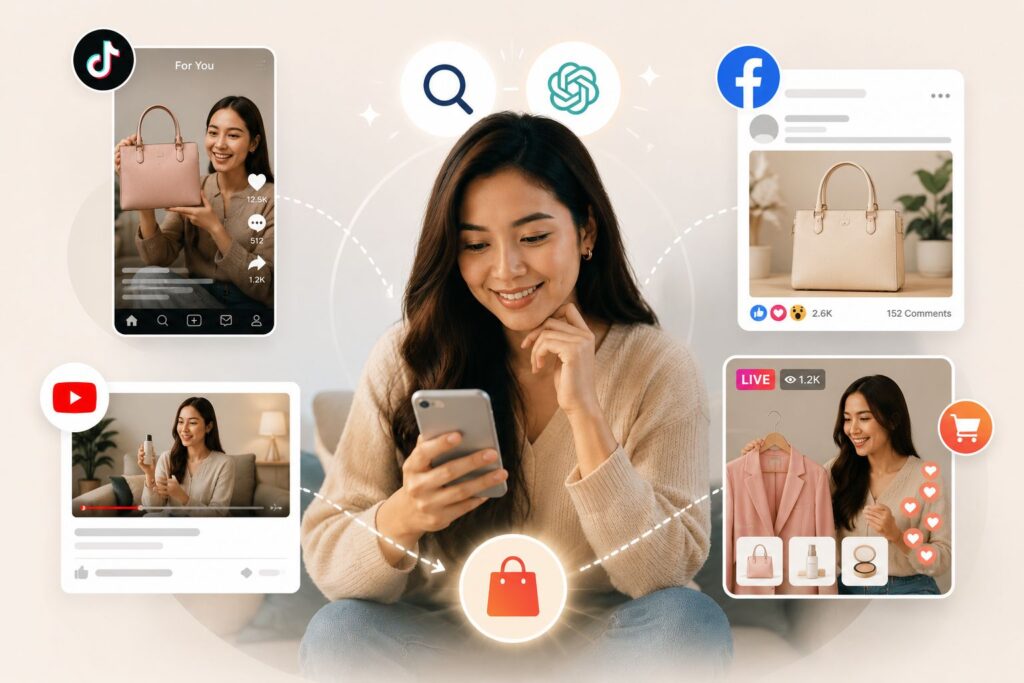
This loop, social to marketplace to messaging to peer review and back to social, is the core of Filipino digital commerce in 2026. Each stage requires a different marketing approach. Understanding the full loop is what separates brands that grow from brands that just spend.
Stage 1: Discovery — Where Filipinos First Learn About a Product
Discovery is the top of the loop, the moment a Filipino consumer first encounters a product or brand they did not know they were looking for. In 2026, this happens overwhelmingly on social media, through video content, and increasingly through AI-assisted search.
Social Media as the Primary Discovery Engine
41.9% of Filipinos discover new brands through social media platforms, and 60% use social media specifically to discover new products and services, making social the single most important discovery channel in the country.
Social platforms in the Philippines function less like entertainment channels and more like product discovery engines. Consumers scroll, see a product demonstrated in a video, and their consideration journey begins, often without any active search intent. They were not looking for your product. Your product found them.
The three dominant discovery platforms in 2026 are:
- TikTok: 62.3 million users aged 18 and above. Filipinos spend an average of 40 hours and 39 minutes per month on TikTok — the highest of any platform. TikTok ads reach 81.8% of all Filipino adults.
- Facebook: 109 million active Filipino users as of early 2026, reaching 90.3% of the total population. The largest demographic is aged 25 to 34 (37 million users). Nearly 95% of Filipino internet users used Facebook in the past month — well above the global average of 57%.
- YouTube: The Philippines ranks 1st globally for online video consumption — 97.2% of internet users aged 16 to 64 watch online videos every week. Over 80% of Filipinos use YouTube monthly.
If your brand has no organic presence on TikTok or YouTube in 2026, 60% or more of your potential Filipino customers are discovering competitors instead. Static posts and image-only campaigns are no longer sufficient as the primary discovery mechanism. Video is the entry point.
The Rise of Livestream and Video Discovery
The Philippines ranked 1st globally in online video consumption, with 97.2% of internet users watching online videos every week. Filipinos also spend more than 20 hours weekly watching online video content, the second-highest in the world. (Source: Digital 2026 Report, Meltwater and We Are Social, October 2025)
Live selling platforms — TikTok Live, Shopee Live, Facebook Live, and Lazada Live, are now significant discovery channels, particularly for beauty, fashion, food, and personal care. The dominance of beauty on TikTok Shop (28% of its total GMV in the Philippines) is direct evidence of how well video demonstration converts in this market. Products that require showing, skincare application, food preparation, clothing try-ons, perform exceptionally well in the live format.
Brands that entertain first and sell second are outperforming those that simply list products and describe features. The Philippines is a market where storytelling and demonstration convert far better than specification-led content.
Word of Mouth and Peer Recommendations
Underneath all the platform data sits a cultural reality: Filipino consumer culture is deeply community-oriented and peer-trust-driven. “Saan mo nabili?” (“Where did you buy that?”) is a genuine discovery mechanism, and its digital equivalent is product tagging, haul videos, and group chat recommendations.
Academic research on Filipino consumer behaviour consistently finds that peer recommendations and influencer content are more trusted than traditional brand advertising. A study published in the Ilomata International Journal of Management (January 2026) found that Generation Z Filipinos view influencer-generated content as more trustworthy than conventional ads — and that micro- and nano-influencers are particularly effective due to their perceived authenticity and peer-like relationship with followers.
Source: Ilomata IJJM — Social Media Influencer Attributes’ Impact on Generation Z Filipino Consumers (2026)
AI and Search-Based Discovery — The Fast-Rising Channel
42.4% of Filipinos aged 16 and above use ChatGPT monthly, ranking the Philippines 6th globally, far above the world average of 26.5%.
Source: Digital 2026 Report — Meltwater and We Are Social (October 2025)
AI-assisted discovery is moving faster in the Philippines than almost anywhere else. When nearly half the adult internet population is already using generative AI tools monthly, those tools become a meaningful product discovery channel, not a distant future trend.
Google remains the dominant search engine for deliberate, high-intent product research, particularly for higher-ticket categories like electronics, appliances, and financial products. For businesses, this means optimizing for both traditional SEO and for AI-generated answers, generative engine optimization, is no longer optional.
Stage 2: Research and Evaluation — What Filipinos Do Before They Buy
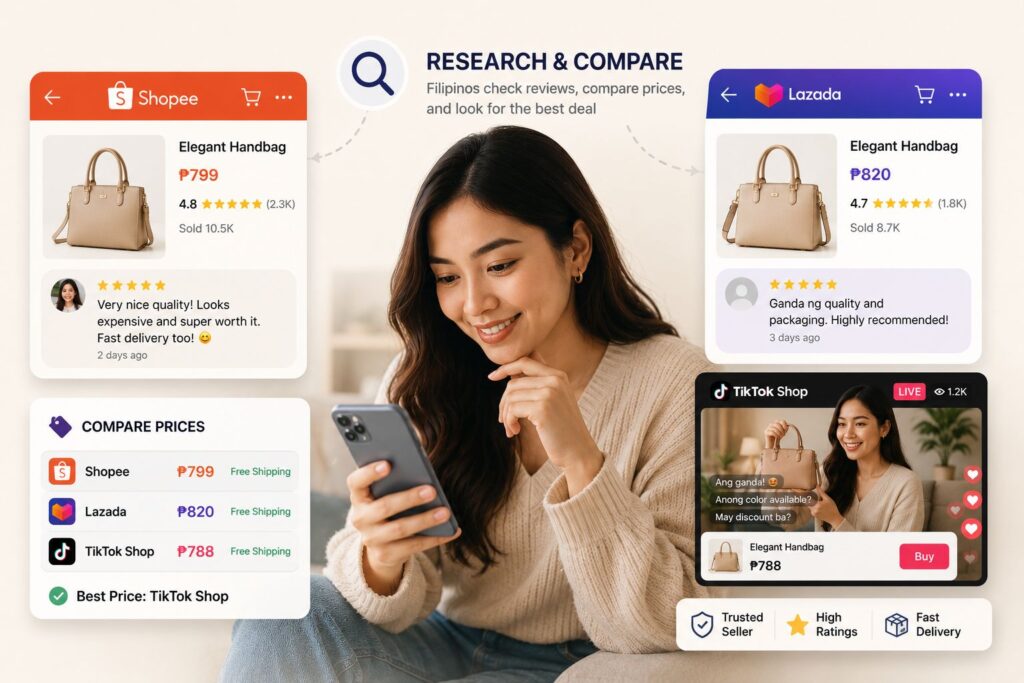
Discovery triggers interest. Research confirms or kills it. This stage — the evaluation phase — is where Filipino consumers compare options, verify quality, and decide which platform to buy from. It is the most underrated stage in most brands’ marketing plans, and the one with the highest leverage over the final sale.
Platform Reviews Are Make-or-Break
Product reviews on Shopee and Lazada are not supplementary information, they are the primary trust signal that determines purchase decisions on those platforms. A peer-reviewed study surveying 403 Filipino Shopee users in Baguio City found that review credibility, information-seeking behavior, and trust directly shape both purchase intent and repeat buying behavior.
Globally, BrightLocal found that 98% of consumers read reviews before making a purchase. In the Philippines, where peer trust is a particularly strong cultural driver, this behaviour is even more entrenched. Sellers with low review scores, few reviews, or unanswered negative comments lose sales not just from persuadable buyers — they lose from the algorithmically driven listing rankings that deprioritise low-rated products. Your review score is, effectively, your search ranking on the marketplace.
How Filipinos Choose Between Platforms
Not all products are bought on the same platform. Filipino consumers have become sophisticated about which platform suits which purchase type. How the three dominant platforms compare in 2026:
- Shopee — 42% market share, average order value PHP 316. Dominates FMCG, fashion, and everyday goods.
- TikTok Shop — 15% market share, up 53% year-on-year. Average order value PHP 198. Dominates beauty, fashion, and impulse categories driven by live selling.
- Lazada — 28% market share, down 34% year-on-year. Average order value PHP 416. Retains premium electronics and verified brand-store purchases.
Source: Cube Asia — E-commerce in Philippines: Market Size, Platforms and Trends 2026
The platform divergence is accelerating. TikTok Shop’s 53% GMV growth versus Lazada’s 34% contraction in FY2025 is not just a market share shift, it reflects a fundamental change in how Filipino consumers want to discover and buy. TikTok Shop is winning impulse and demonstration-driven purchases. Lazada is holding premium and brand-verified purchases. Shopee remains the broadest, most reliable platform for everyday commerce.
The Multi-Platform Comparison Habit
Over 95% of Filipino online shoppers use at least two marketplaces before making a purchase decision.
Source: Cloud Ecommerce — Philippines Ecommerce Report 2026
Filipino consumers are disciplined comparison shoppers. The cultural norm of tawad — negotiating for the best price — has translated directly into digital behaviour: checking Shopee, then Lazada, then sometimes TikTok Shop, to find the best combination of price, seller rating, and delivery speed before committing.
Stage 3: The Purchase — How and Where Filipinos Actually Buy
Mobile Commerce Is the Default, Not the Exception
The Philippine online purchase happens on a smartphone. This is not a preference, it is simply the device most Filipinos use for everything digital. With cellular connections exceeding the total population and the majority being broadband-capable, mobile is the default internet interface for the vast majority of Filipino consumers.
For businesses, this has one non-negotiable implication: if your website loads slowly on mobile, your checkout process has too many steps, or your product pages are not optimized for a small screen, you are losing buyers at the final moment of decision. Google’s Core Web Vitals directly affect search rankings in the Philippines, slow, mobile-unfriendly sites are penalized both by users and by the algorithm.
Social Commerce and In-App Purchasing Are Mainstream
40% of Filipinos make direct purchases through social media platforms, Facebook Marketplace, Instagram Shopping, TikTok Shop, and in-app checkout — without ever leaving the app.
TikTok Shop’s integration of product listings, live selling, and checkout into a single app experience is the clearest example: a Filipino consumer can discover a product in a TikTok video, watch a live selling demonstration, read reviews, and complete payment without leaving the app.
Facebook Marketplace and Facebook Live selling remain particularly strong in provincial markets and for categories like fashion, food, and personal care, where a personal relationship with the seller, maintained through Messenger, drives repeat purchases. This is a distribution channel that many brands overlook because it does not fit neatly into traditional e-commerce analytics dashboards.
Sale Culture Drives Purchase Timing
Filipino online purchasing is not evenly distributed across the month. Platform-driven sale events, Shopee’s monthly sale days (1.1, 2.2, through to 12.12), Lazada’s flash deals, and TikTok Shop’s live sale events, concentrate purchase volume into specific windows.
Singles’ Day on 11 November and 12.12 remain the two highest-volume shopping days of the year across all Philippine platforms. Brands that run dedicated creative, prepare discounts in advance, and participate in platform-featured deals consistently outperform their annual averages. Missing these windows is the equivalent of closing your shop on the busiest days of the year.
Stage 4: Post-Purchase — The Loop That Feeds the Next Buyer
Most marketing analyses stop at the purchase. The Filipino consumer journey does not. Post-purchase behavior, reviews, sharing, unboxing content, group chat recommendations, is the engine that drives the next cycle of discovery. Brands that activate this stage multiply the value of every sale they make.
Reviews Close the Loop
Filipino consumers review actively, particularly on Shopee and Lazada. Review volume and recency are key ranking signals on both platforms — sellers with consistent recent reviews rank higher in search results and appear more frequently in algorithmic recommendations.
The mechanism is self-reinforcing: sellers who encourage reviews get more reviews, which improves platform ranking, which increases visibility to new buyers, which generates more sales and more reviews. Sellers who do not actively encourage post-purchase feedback fall behind in platform search rankings regardless of product quality.
User-Generated Content as Free Media
Unboxing videos, product hauls, “is it worth it?” reviews, and before-and-after demonstrations are dominant content formats on TikTok, YouTube Shorts, and Facebook in the Philippines. This user-generated content is trusted by other Filipino consumers precisely because it is not produced by the brand — it carries the authenticity of a peer recommendation delivered at the scale of a media channel.
Research published in the Journal of Economics, Management and Trade (2025) found that exposure to peer reviews and influencer endorsements fosters credibility in Filipino consumers, directly affecting brand trust, loyalty, and purchase intent, consistently across Facebook, Instagram, TikTok, Twitter/X, and YouTube.
For brands, the implication is practical: every customer is a potential content creator. Building a post-purchase flow that makes it easy and rewarding to create and share content, through packaging that encourages photography, follow-up messages requesting reviews, or referral incentives, turns a single sale into a recurring discovery asset that compounds over time.
What This Means for Philippine Businesses — 5 Practical Implications
The data across all four stages of the Filipino consumer journey points to five clear priorities for any business marketing to Filipinos in 2026. These are not trends to monitor — they are requirements to meet.
1. You Need a TikTok and YouTube Presence — Not Just a Facebook Page
Discovery is moving to video-first platforms at speed. TikTok reaches 81.8% of Filipino adults through its ad platform. YouTube is used by over 85% of Filipinos monthly. A brand with no video content strategy is invisible during the most influential stage of the consumer journey.
2. Reviews Are Your Most Powerful Sales Tool — Build a System to Collect Them
On Shopee and Lazada, your review score and volume directly determine your search ranking and conversion rate. Implement a post-purchase follow-up — a Messenger message, a packaging insert, a voucher for the next order in exchange for a review — that makes leaving feedback easy. This is low-cost, high-impact, and compounds over time.
3. Nano and Micro-Influencers Outperform Celebrities for Conversion
Filipino consumers trust peer-level content creators more than brand spokespeople. An influencer with 20,000 highly engaged followers in your niche will drive more measurable purchase behaviour than a celebrity post seen by millions. Budget accordingly — and focus selection on credibility and audience fit, not follower count alone.
4. Mobile Experience Is Non-Negotiable
If your website takes more than 3 seconds to load on a mobile connection, or your checkout has more than four steps, you are losing buyers at the final moment of conversion. Audit your Core Web Vitals in Google Search Console, simplify your checkout flow, and test your site on a mid-range Android device — not a desktop. That is the device your customers are using.
5. Build a Sale Calendar and Show Up in It
Platform sale events — 11.11, 12.12, and monthly sale days — are not optional for Philippine e-commerce brands. Prepare dedicated creative in advance, set promotional pricing, participate in platform-featured deals where possible, and align your ad spend with the days when purchase intent peaks.
The Takeaway
The Filipino consumer journey in 2026 is not a funnel, it is a loop. A product is discovered on TikTok or Facebook, researched through Shopee reviews and peer recommendations, purchased on mobile via in-app checkout, and then shared as content that feeds the next buyer’s discovery.
Brands that understand and design for each stage of this loop, not just the purchase moment, build compounding digital assets rather than one-time campaigns. Every review earned is a future ranking signal. Every piece of customer-generated content is a future discovery touchpoint. Every satisfied buyer reached through the right influencer becomes a peer recommendation in someone else’s group chat.
The data is clear about where Filipino attention lives: social media platforms, particularly TikTok and YouTube for video discovery, and Shopee and TikTok Shop for purchase. The brands allocating budget and creative energy where that attention actually is, rather than where it was five years ago, are the ones growing in the Philippine market in 2026.
Sources
| Source | URL | Notes |
| Meltwater & We Are Social — Digital 2026 Philippines Report | https://www.meltwater.com/en/blog/social-media-statistics-philippines | Main data source for social media, time-online, AI stats |
| GMA News — Filipinos Lead in Online Shopping (Oct 2025) | https://www.gmanetwork.com/news/scitech/technology/963273/filipinos-lead-in-online-shopping-video-streaming-global-report/story/ | News coverage of Digital 2026 PH findings |
| DitoSaPilipinas — Digital 2026 Report Coverage (Oct 2025) | https://www.ditosapilipinas.com/national/news/article/10/24/2025/filipinos-worlds-most-digitally-engaged/2112 | 56.4% weekly shoppers, ChatGPT adoption |
| DataReportal — Digital 2026: The Philippines | https://datareportal.com/reports/digital-2026-philippines | TikTok ad reach 81.8%, platform data |
| Cube Asia — E-commerce in Philippines 2026 | https://cube.asia/e-commerce-in-philippines/ | Platform GMV, market share, avg order values |
| Cloud Ecommerce — Philippines Ecommerce Report 2026 | https://www.cloudecommerce.com/blog/philippines-ecommerce-report-2026-market-size-growth-trends-and-key-insights/ | 95%+ multi-platform shopping stat |
| Mordor Intelligence — Philippines E-Commerce Market 2026 | https://www.mordorintelligence.com/industry-reports/philippines-ecommerce-market | Market size $20.05B, CAGR projections |
| Radar.ph / DMAP — Filipino Brand Discovery (Feb 2026) | https://radar.ph/filipino-consumers-drive-brand-discovery-through-offline-digital-and-ai-channels/ | Gen Z & Gen X discovery channel behaviour |
| NapoleonCat — Facebook Users Philippines 2026 | https://stats.napoleoncat.com/facebook-users-in-philippines/2026/01/ | 109M Facebook users, 90.3% population reach |
| IJFMR — Shopee Online Reviews on Consumer Purchasing (2025) | https://www.ijfmr.com/papers/2025/5/57457.pdf | 403-respondent study on review trust |
| Ilomata IJJM — Influencer Impact on Gen Z Filipinos (2026) | https://www.ilomata.org/index.php/ijjm/article/download/1968/1020 | Nano/micro-influencer trust finding |
| GWI — Filipino Consumer Report | https://www.gwi.com/reports/philippines-consumers | Consumer behaviour baseline data — note: 2020 edition, treat as background only |
| ESQUIRE PH — Philippines Social Media Use 2025 (Jan 2026) | https://www.esquiremag.ph/culture/tech/philippines-social-media-use-2025-a5260-20260129-dyn | 95% of PH internet users on Facebook monthly stat |

Joel Madtha is a strategic business leader, growth marketing expert, and transformation consultant with 20+ years of experience helping businesses scale with precision. Through joelmadtha.com, he shares insights on leadership, business growth, M&A strategy, and operational excellence. He is also the author of Determined Not Determined, focused on resilience, execution, and sustainable success.